
Hard-to-Change Factors and Split-Plot Designs, Explained
Part of our complete guide to DOE for biologists.
Most Design of Experiments guides assume every run can be executed in any order, with every factor reset independently between runs. In a lab, that's often not true — and pretending otherwise is what makes split-plot designs necessary.
The problem: some factors are expensive to reset
Say you're optimizing a CHO cell culture process across three factors: Temperature, Glucose Feed, and Media Type. Glucose Feed and Media Type are easy — you can change them run to run. Temperature is different: it means re-equilibrating an incubator or a bioreactor, which might take hours and isn't something you do eight times in a row just to satisfy a randomized run order.
If you design this as a fully randomized experiment anyway, you have two bad options: actually pay the cost of resetting temperature between every single run, or quietly run temperature in blocks while the design assumes you didn't — which inflates your confidence in temperature's effect more than the data actually supports.
The fix: flag it as Hard-to-Change
In BioDOE, check Hard-to-Change next to any factor that's genuinely expensive or slow to reset.
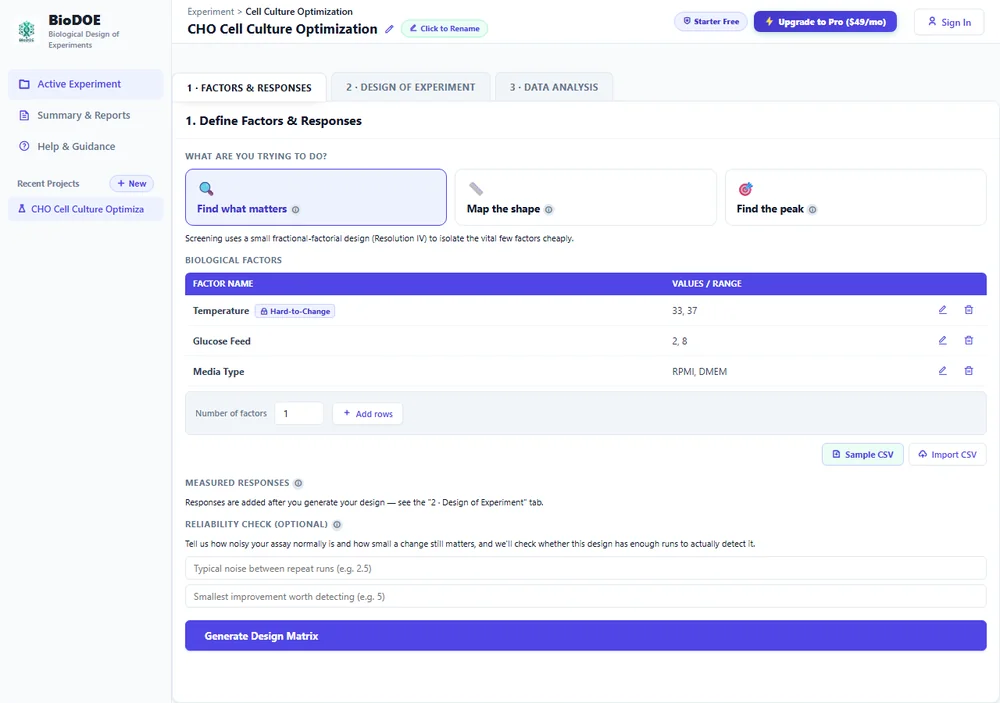
Generate the design and the run order changes: instead of full randomization, runs are grouped into whole plots — contiguous blocks that all share the same Temperature setting — with Glucose Feed and Media Type (the easy-to-change factors) randomized within each group.
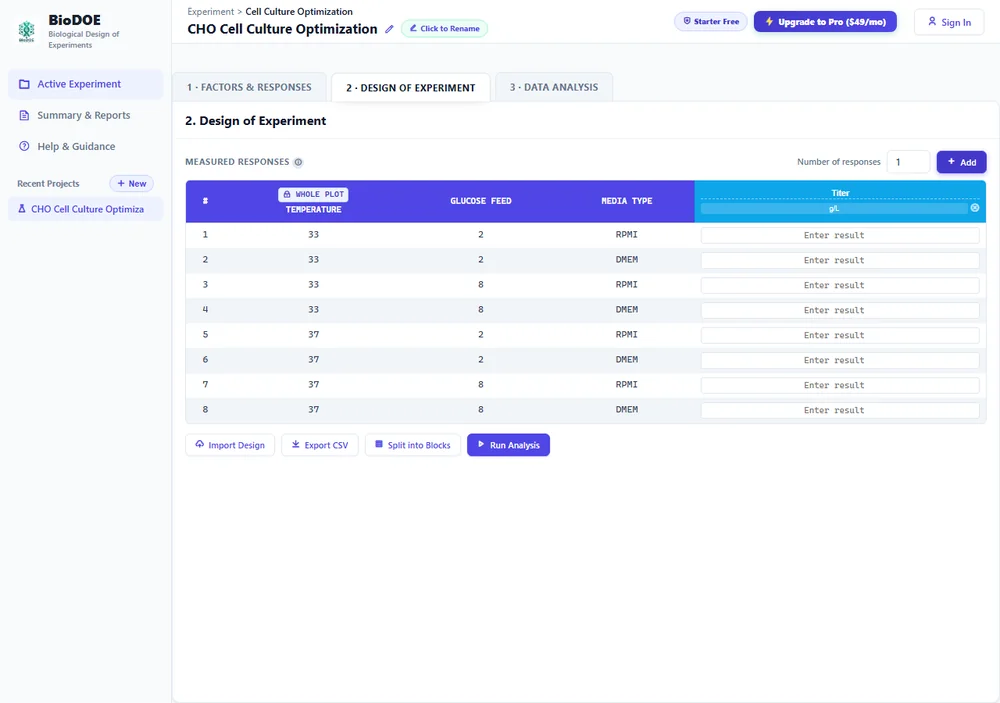
This is a split-plot design: Temperature varies at the "whole plot" level, everything else varies at the "subplot" level within it. It matches how you'd actually run the experiment on the bench, instead of asking you to pretend otherwise.
Why this matters for your analysis
A whole-plot factor and a subplot factor aren't estimated with the same precision, because they're not replicated the same way — Temperature only actually changes twice in the example above, while Glucose Feed and Media Type each change on every run. A standard ANOVA that treats every run as independent overstates how confident you can be about Temperature's effect specifically.
BioDOE fits split-plot designs with REML (a mixed-effects model that treats whole-plot and subplot variance separately), so the p-value you see for a Hard-to-Change factor already accounts for this — you don't need to compute it by hand or explain it to a reviewer after the fact. If there aren't enough whole-plot groups for that model to converge, BioDOE falls back to a standard fit and says so explicitly in the results, rather than silently reporting a number that's more confident than it should be.
When to use it
Flag a factor as Hard-to-Change when resetting it between every run would be impractical or so costly you wouldn't actually do it — equipment that needs re-calibration, incubator or bioreactor temperature, anything requiring a physical setup change. Leave factors alone if they're genuinely as easy to change as pipetting a different concentration.
Split-plot (Hard-to-Change) designs and their REML analysis are a Pro feature in BioDOE — screening and characterization designs with fully randomized factors are available on the free Starter plan.